For sometime I have been thinking about writing of our immigration to Canada and our early life here but it is rather difficult because I was too young to make any notes and unable to give the exact dates although I do remember individual happenings which I experienced. I remember the people and locations.
In 1896 my late father, John Hryhorczuk, together with the late Wasyl Syrotuik [margin: Syrotuik], from the village of Balenec, decided to send the late George Syrotuik to Canada to observe life there. George went and in a short time wrote us to come to Canada immediately because in Canada a settler could get 160 acres of land for $10.00. The land was good with plenty of timber and pasture. Wasyl Syrotuik, my father and his family, started preparing for the long journey. The people of Syrotuik’s village shed tears on his departure. They were sorry to lose a well-educated neighbour and see him go into the far unknown.
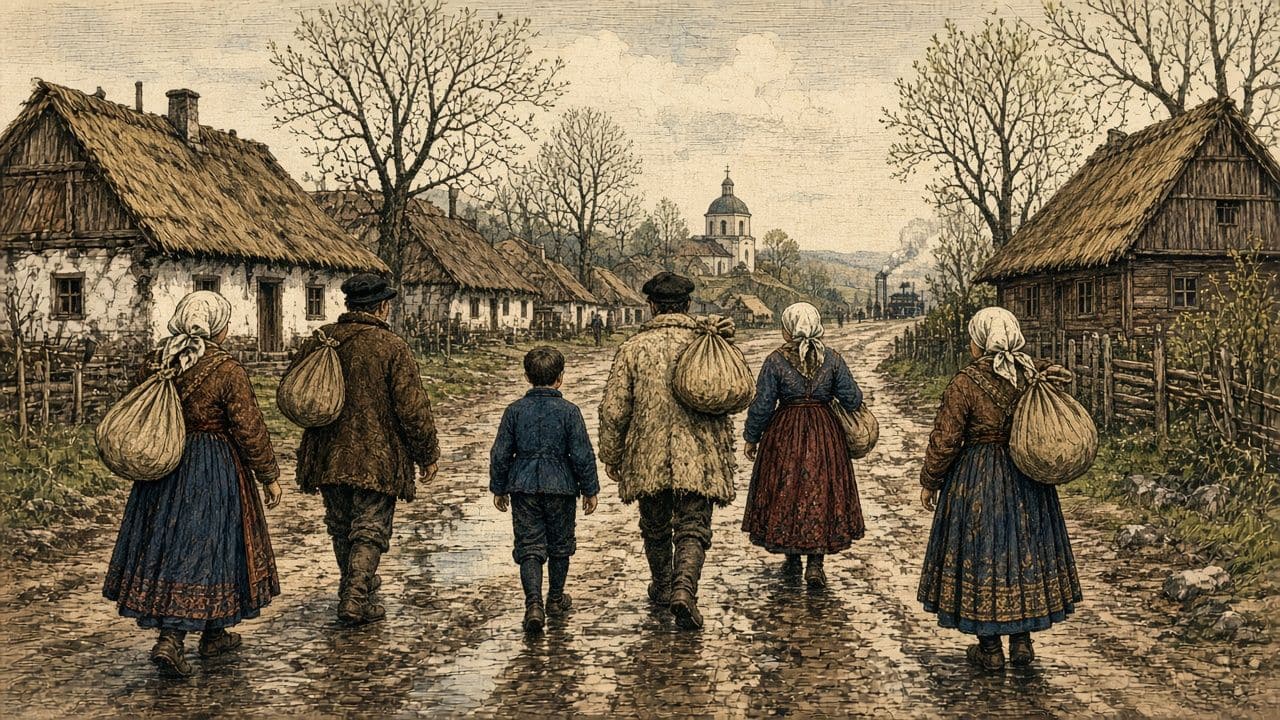
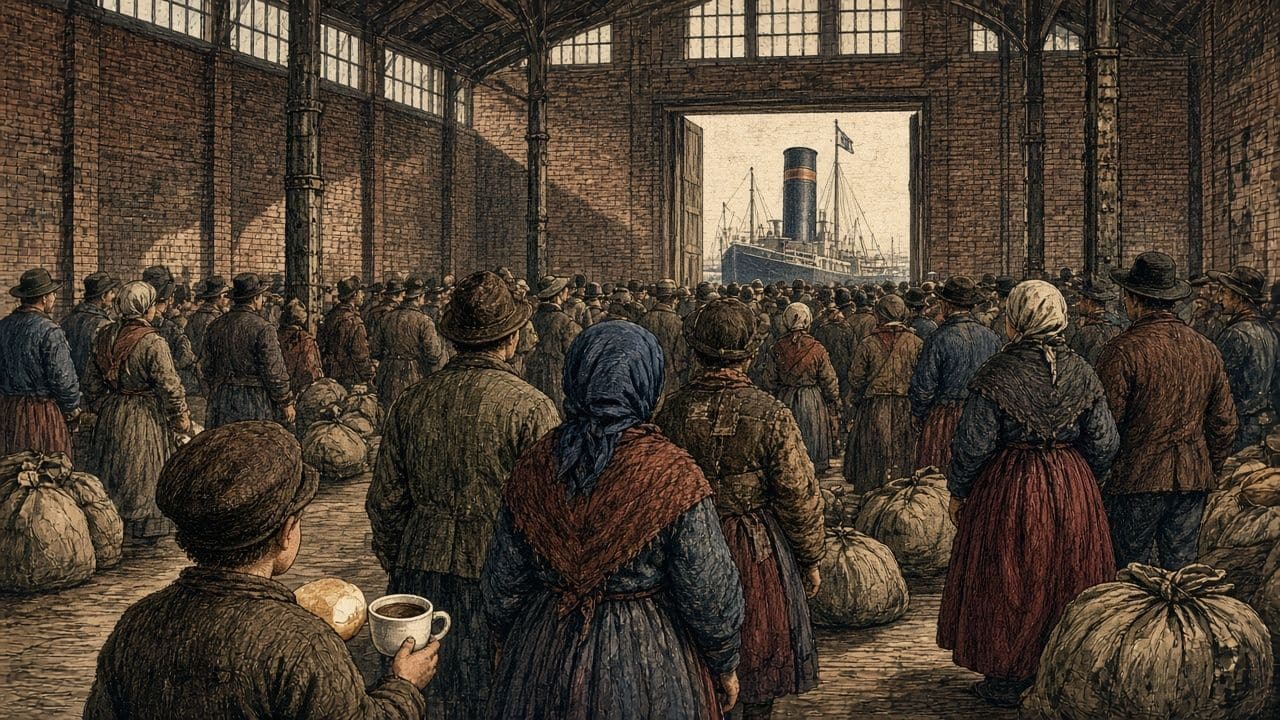
The same destiny was ours. We lived in an adjoining community, Euchachky, in the county of Kolomaya. I remember that it was Easter and I got a new suit and shoes and looked like a landlord’s son. At that time I was nine years old and never gave a thought as to what we were doing or where we were going. I was happy just to be all dressed up. I still remember how our neighbours accompanied us to the railway station. There were six of us. My father, mother, a brother George, 7 years of age, a sister Mary, 4 years of age and Dora, one year old. I recall that we went through the capital of Kolomaya. I guess I remember it because this was my first trip there. For some reason, I can also remember very clearly our stop in Hamburg, Germany. Maybe it was because I had a bun and very good coffee there.
Illustration: neighbours walking the family to the train at Easter, 1896. The figures are not likenesses.Illustration: the stop in Hamburg for a bun and coffee. Not a portrait.Archival photograph
The market square in Kolomyia — the memoir’s Kolomaya — between 1900 and 1904. Nicholas remembered passing through the town on the way to the train. Archival photograph, not the Hryhorczuk family.
SourceArchival image
Emigrants boarding a steamer at Hamburg, a nineteenth-century engraving. The memoir remembers a stop there for a bun and coffee. This picture is not their ship, and the print’s own caption sends the crowd toward New York.
Source
Illustrated online edition. The memoir text follows the 2011 copy compiled by Rene Nicholas Bilodeau.