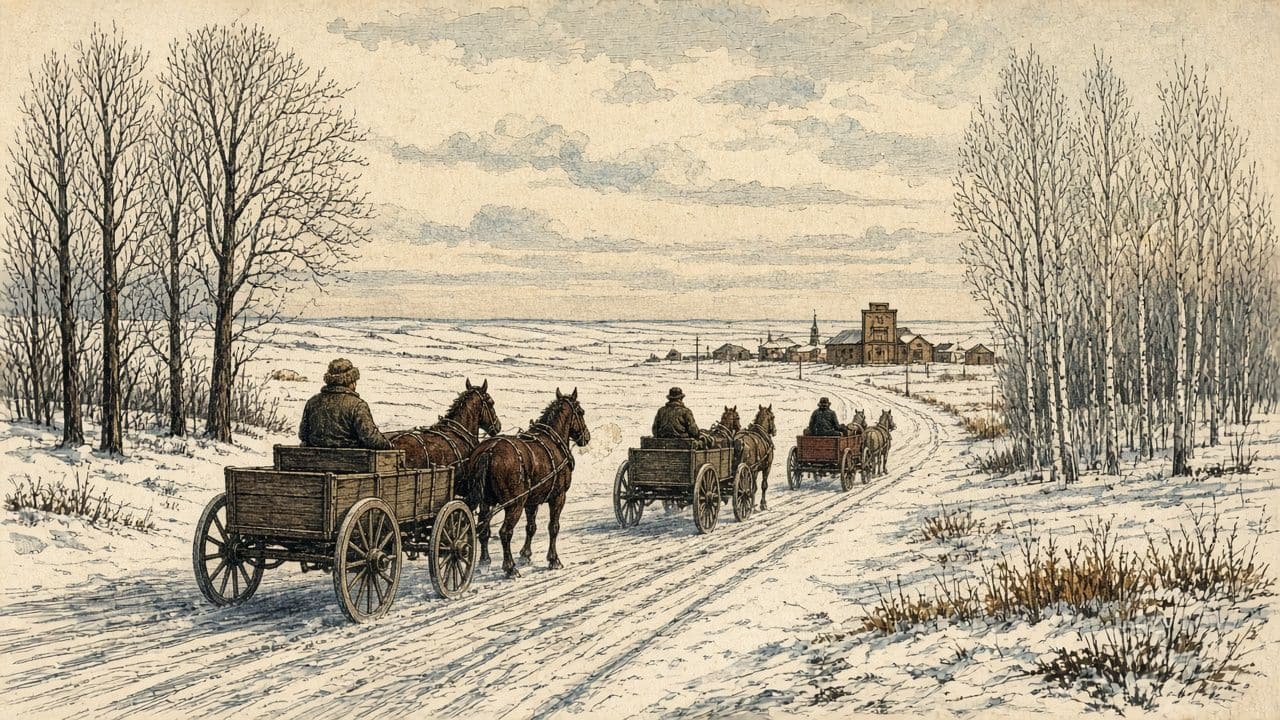
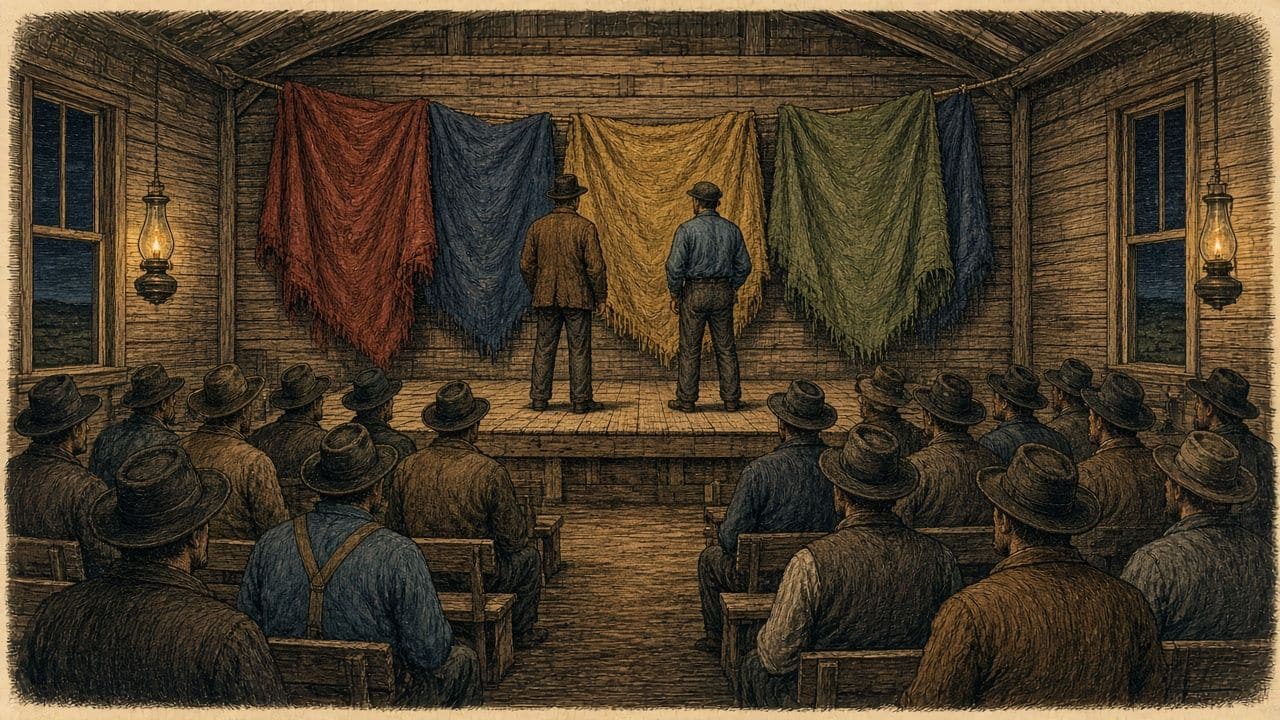
Our society, “Seech”, was more active during the winter months when there wasn’t too much work on the farms. We staged a few plays. In the winter of 1911 I made the suggestion that our theatrical group in Venlaw stage a play in Ethelbert, which was twenty miles away. We made the trip in horse-drawn wagons on a cold frosty day. The name of the play was “Ubynyk” (Killer). Because I was travelling away from home and could not practise with the group, I rehearsed for the play by myself in my hotel room. I joined the group on the night of the performance. The play was staged in the poolroom building which also served as a schoolhouse. The chairman of the school board, Mr. Katz, agreed to let us have the use of the building. With the help of some local people, among them Mike Wolochatiuk, Alex Magis, Ivan Kowcun and Petro Kuzyk, we built a platform for a stage. For walls, we used different coloured blankets. Admission was twenty-five cents. This was the first play to be seen in Ethelbert and was well received by the Ukrainian residents.
Illustration: the cold wagon trip from Venlaw to Ethelbert to stage a play, 1911.Illustration: the Ethelbert play, coloured blankets hung for walls.Archival photograph
A Ukrainian dramatic society in 1914. Wikimedia Commons identifies the photograph as a company in Winnipeg. The placard names a drama society; it is not the Venlaw or Ethelbert cast, who hung blankets for walls.
Source
In the spring of 1911 we moved to Ethelbert. The population was approximately seventy-five percent Ukrainian. At that time our family consisted of two boys, Michael and William. Eventually our complete family numbered six. A third son, Ross, and three daughters, Rose, Nadia and Violet were all born in Ethelbert.
Family photograph
A photo taken at a later time with all the children. From left to right: Ross, William, Michael, "Gido", "Baba", Rose, Nadia, Violet. Family photograph, from the 2011 edition compiled by Rene Nicholas Bilodeau.
Family photograph
Anastasia and Nicholas Hryhorczuk and sister Mary Dzaman in backyard of home in Ethelbert. Family photograph, from the 2011 edition compiled by Rene Nicholas Bilodeau.
In order to continue staging plays it was necessary to have a hall. In the summer of that same year we had the first meeting of the settlers in the community and decided to go ahead with erecting a building. We organized a society under the name of Taras Shevchenko. Alex Magis was elected chairman of the society. At that first meeting it was decided that the clergy of any church would be elected to the executive. The reason for this was that at that time there were serious misunderstandings among the different churches. It was also decided that no religious matters were to be discussed in the building. The property was not to be allowed to pass into the hands of any religious sect. Any church or organization could have use of the building when it was not needed by the society.
Membership fee was $5.00 and any Ukrainian could be a member of the society regardless of his church, political beliefs and affiliations. Since we had no capital with which to start, a member of the society, besides paying his membership fee, also agreed to do free work on the construction of the building. Before the building was completed we began staging plays. Admission was twenty-five cents. As we made a little money and obtained a small loan, we were able to complete the building.
At that time we had several Ukrainian school teachers in the municipality. Their work, interest in the community and leadership meant a great deal to the settlers. They not only taught our children but also worked among the adults. Saturdays, Sundays and evenings were spent among the people, giving lectures on different subjects such as citizenship, farming, education and theatrical work. Most of them took part in the plays and it was nothing for them to walk ten and fifteen miles to rehearsals, over roads that were almost impassable. We are very grateful to these men. They are still in my memory and I will mention the names of at least some of them - Ivan Hryciuk, Ivan Wichkowski, Anton Skorbohach, Ivan Ruydachek, Michaylo Malkowich, Michaylo Demchuk, Petro Melnyk, Ivan Maschuich [margin: Masciuch/Masciuk]. Besides the school teachers there were other men who used their time to raise the standard of the community. Among them were John Kowcun, Kyrilo Livitski, Peter Kuzyk, Wasl Pernerowski, Stefan Wyshneski and many others.
The young women also contributed to our theatrical group. In spite of the house work, with no conveniences, and rearing the children, they made every effort to attend the rehearsals. My late wife, Anastasia, took part in all the plays that were staged by their taking roles in them or helping and directing the girls in order to make the play a success. In our family when attending rehearsals we had to take one child in our arms, the other in a baby carriage and the third, we led by the hand.
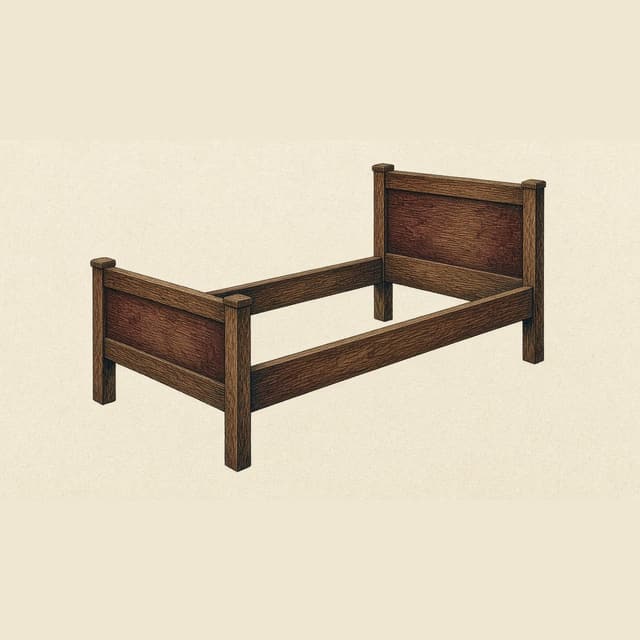
Illustration: the bed carried from home to the stage and never seen again.
Since the hall had no furniture for its stage, it was necessary to bring this from the homes and take it back after the completion of the play. I recall one time when a bed was required on the stage we took the bed from our bedroom. Since the back-stage was not as large as it is now, the bed had to be taken outdoors before the play was finished. Apparently someone thought the bed had been discarded and we never did see it again.
We had no seating accommodation so we took the chairs we had at home to the hall in order that people who had travelled some distance to see the plays could be seated comfortably. For the local people we had blocks of wood and planks, if we could get them. These were what would now be called “hard times” but they were certainly happy days for us.
Illustrated online edition. The memoir text follows the 2011 copy compiled by Rene Nicholas Bilodeau.