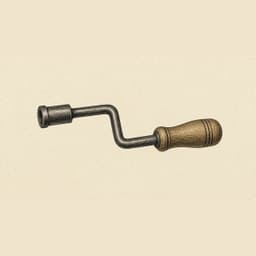
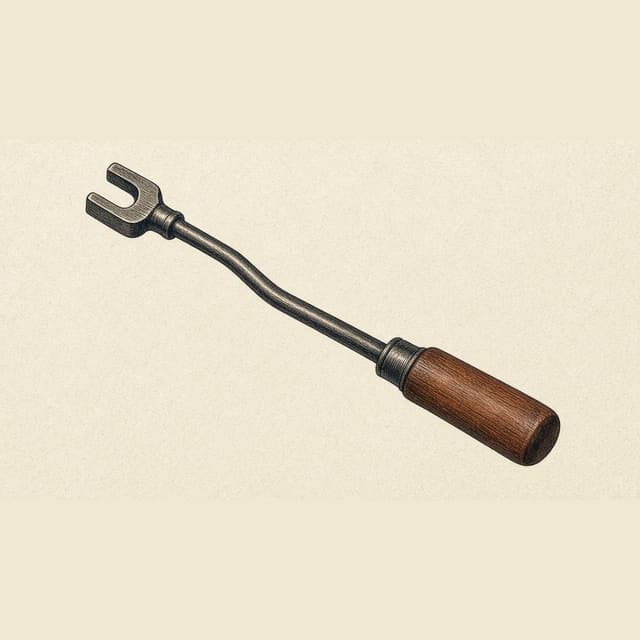
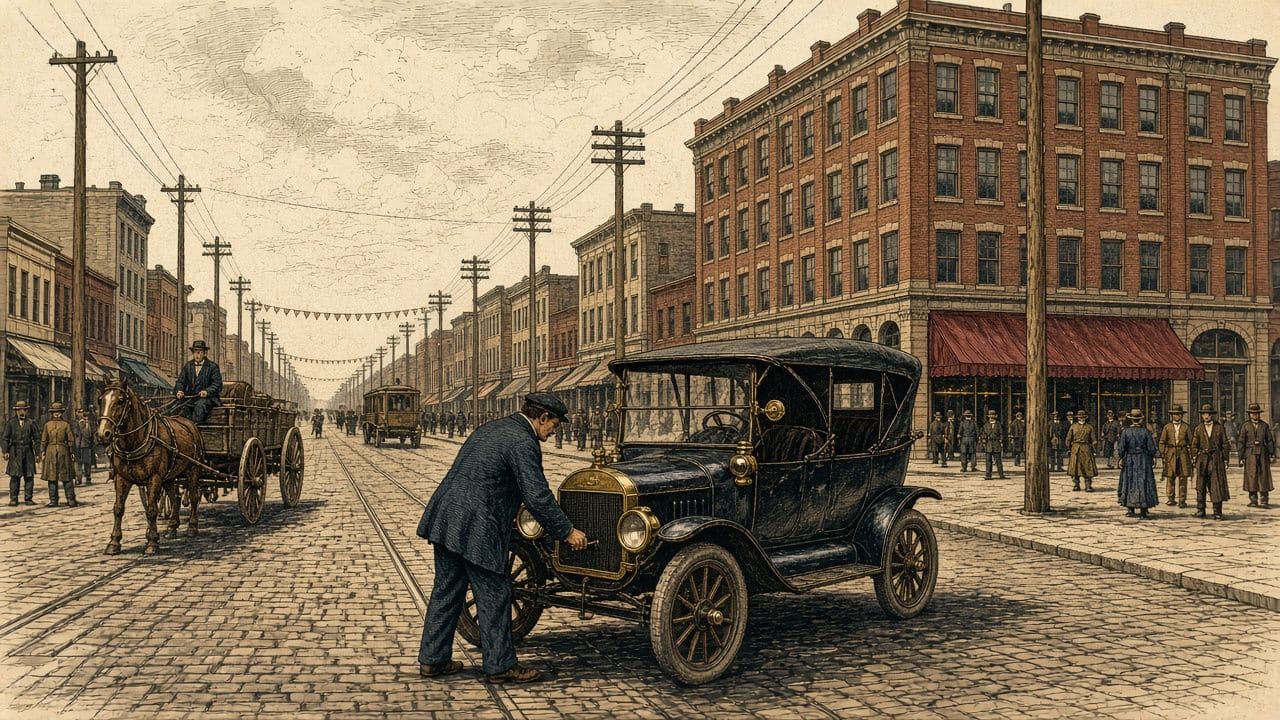
Needless to say there were no cars to be seen in the village or surrounding area. In 1914 while walking along Portage Avenue in Winnipeg, I saw a fellow cranking a Ford car. He was having much difficulty in getting it started. He was very disgusted and told me so. While talking to him we made a deal. I bought the car for $275.00 - paid him cash right on the street without any transfer or receipt, and took possession of the car. Until then I had never driven a car although I had ridden in one while I was employed as a collector by the International Harvester Company. Since there were no other cars in sight, I had no problem driving on Main Street and Portage Avenue. My big problem was getting the car started again after stopping. I had to crank it for a long time before the motor would start. It had four cylinders but most of the time only three operated. I took the car into a garage to get some information and instructions on how to handle the car but apparently the man in charge didn’t know much more about cars than I did.
Illustration: A man cranking an open car on a city street.Archival photograph
Portage Avenue, Winnipeg, looking east past the Eaton’s store, about 1920. Albertype Company. Nicholas bought the Ford on this avenue in 1914; the street in the photograph is a few years later.
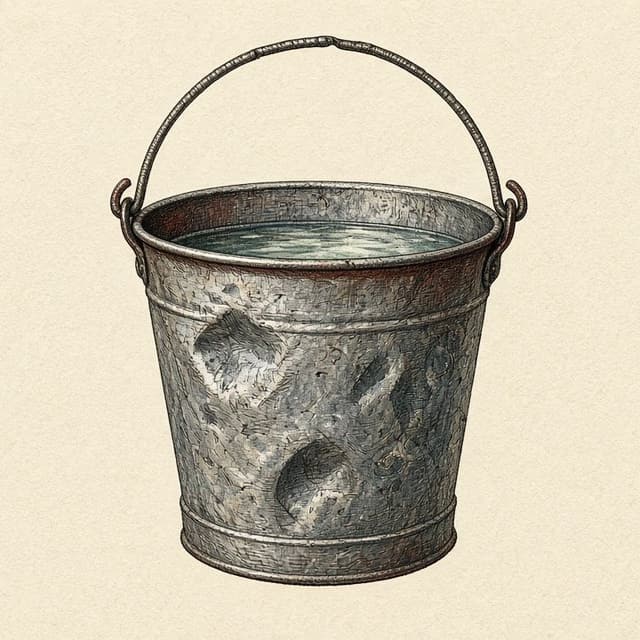
SourceIllustration: A water pail.
The next morning, which was Sunday, I asked a friend to mine (Batryn) to come with me as far as Portage la Prairie. There was no highway, just a winding road. I noticed steam coming from my radiator. On checking, I found that the valve tap had gotten loose and the water had drained out. It was lucky that we had a pail with us and my friend took it and started walking to see if he could find a farmhouse. When the motor cooled, I got it started again and caught up with my friend about a quarter of a mile away. By that time the motor was hot and I had to stop again. Batryn kept on walking while I waited for the motor to cool. When I caught up with him again we were near a farmhouse and so were able to get the needed water. We arrive at Portage in the evening and my friend took the train back to Winnipeg while I stayed overnight with my wife's uncle, Dzaman.
Monday morning, I had to crank for about a half an hour before I could get the car started. The motor made a loud racket and the car shook so much that some of the clay on the walls of my uncle’s house dropped off. He didn’t mind that. He was proud that one of his relatives already had a vehicle that could go without the help of horses.
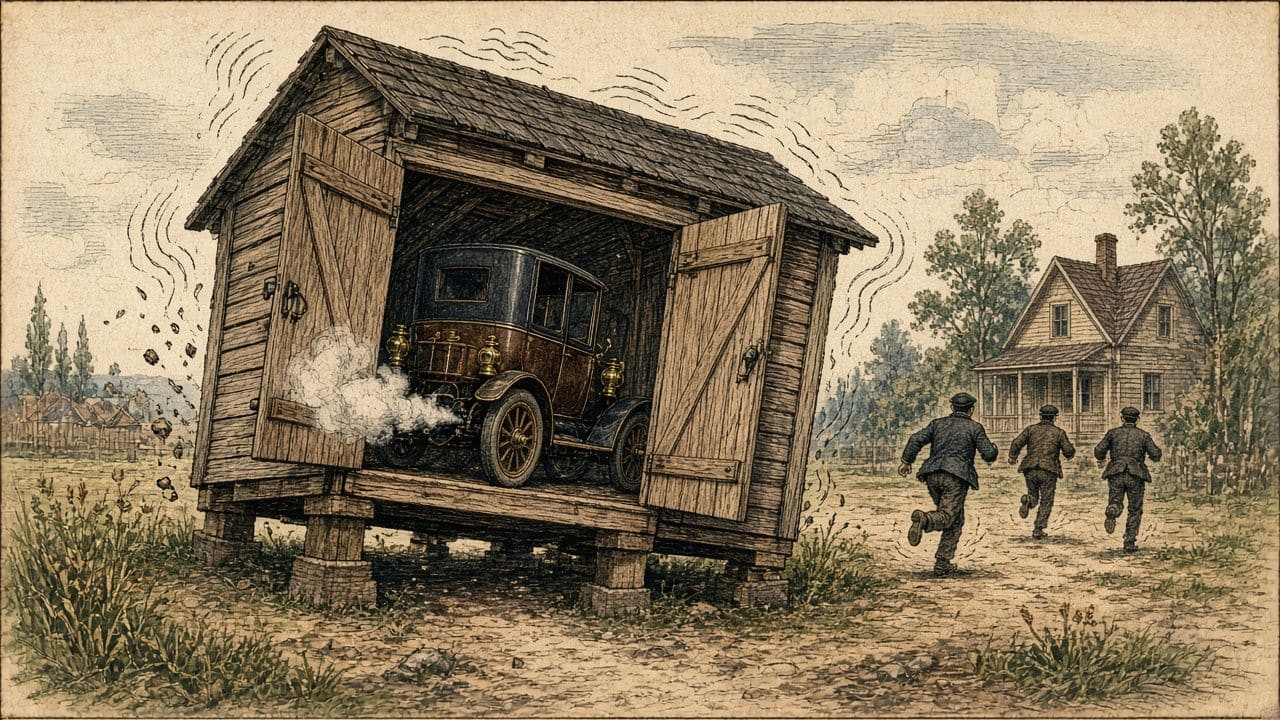
It took two days to get from Portage to Ethelbert. This was the first auto in Ethelbert and when the farmers heard about it they came by foot and by oxen from up to fifteen miles away to see it. The building in which the car was kept was placed on blocks and was not a solid foundation. While a crowd watched me, I tried to start the car. After quite a while, and having no luck, I finally got tired of cranking the darn thing, left it and went home for dinner. In the meantime, one of the men continued to crank the car and it started. The vibration caused the building to shake so much that it appeared that it might collapse. No one knew how to stop the car. They lost no time in getting to my house and I lost no time in getting to the car.
Illustration: A wooden shed with a car inside.
In spite of that everybody, or nearly everybody, made some use of the car. The car served the neighbours and I had the privilege of bringing Bishop Butka from Garland to Ethelbert. I imagine this was his first ride in a car since he arrived in Canada. The farthest we went was to Dauphin and the return trip took a whole day. I remember having sixteen flats in one day.
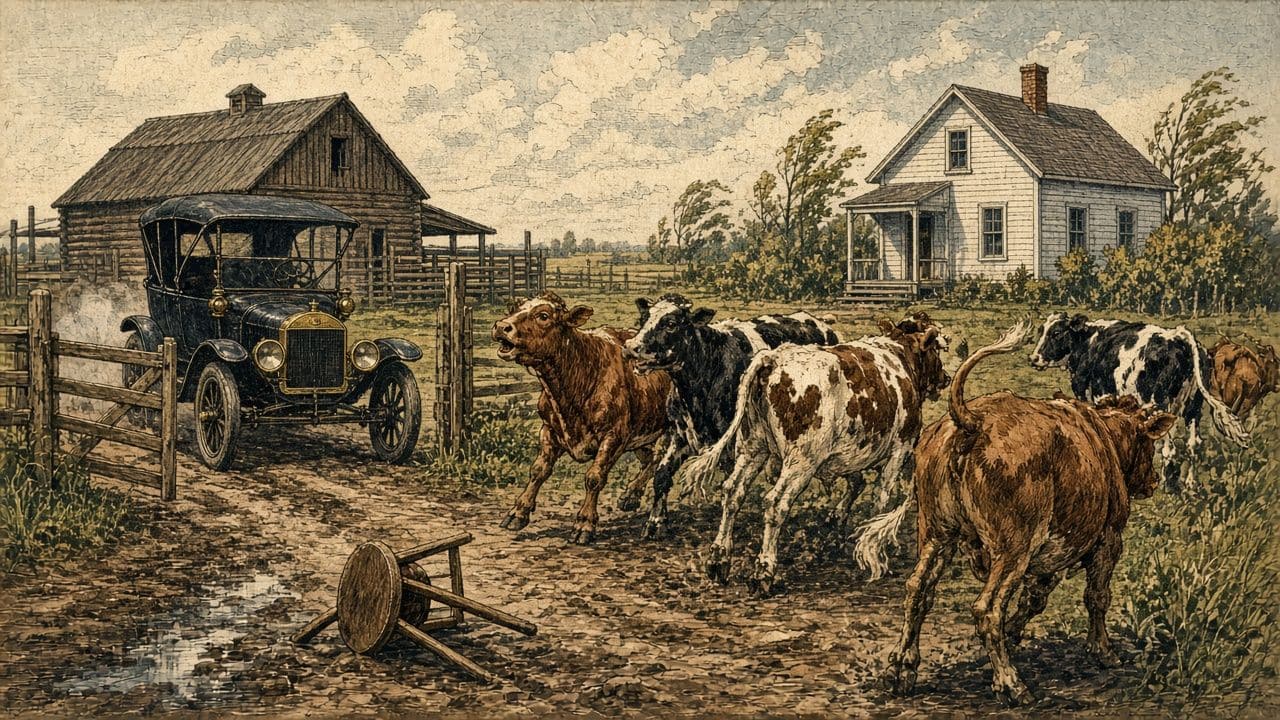
International Harvester Company, for which I was collecting at the time, agreed to pay me $20.00 a week for the use of the car provided I didn’t spend most of the time repairing it and being pulled out of the mud holes. While driving into farmyards, the Ford made such a noise that it scared the cattle in the yards. The result was that the farmers tried to pay their bills as soon as possible to prevent my coming again. They said that some of their cows had stopped giving milk because of the fright they received.
Illustration: Cattle shying from a car in a farmyard.
In 1916 I quit the job on the road with I.H.C. and sold the car to John Kowcun who was in the same business as I was, retailing farm implements. He also had trouble with the car. He said that every morning before starting out from his father’s farm, he hitched a team of horses to the car and towed it around the yard in order to get it started.
As I mentioned before, most of the time the car ran on only three cylinders. Once, after a very windy day, I was going to Pine River. Some trees had been blown down and as I came to one in the middle of the road, I swerved to the right to avoid hitting it. The right wheel hit the tree and the axle got bent a little but all four cylinders started to work. The Ford car was very good - much better than its chauffeur and the roads at the time.
Illustrated online edition. The memoir text follows the 2011 copy compiled by Rene Nicholas Bilodeau.