In 1916 during the First World War I was elected Reeve of the Ethelbert municipality and I recall many unpleasant incidents. The settlers had come from Austria. This created misunderstandings and many thought that we were enemies of Canada. Young men, who wanted to join the army to serve Canada, were turned down as enemies. We had no trouble with the R.C.M.P. but had a great deal of it with part-time policemen appointed by the provincial government.
One was stationed at Pine River and he went around the area apprehending some of the boys. He would bring those he caught before the Justice of the Peace, who would fine the boys five or ten dollars each for some unknown reason.
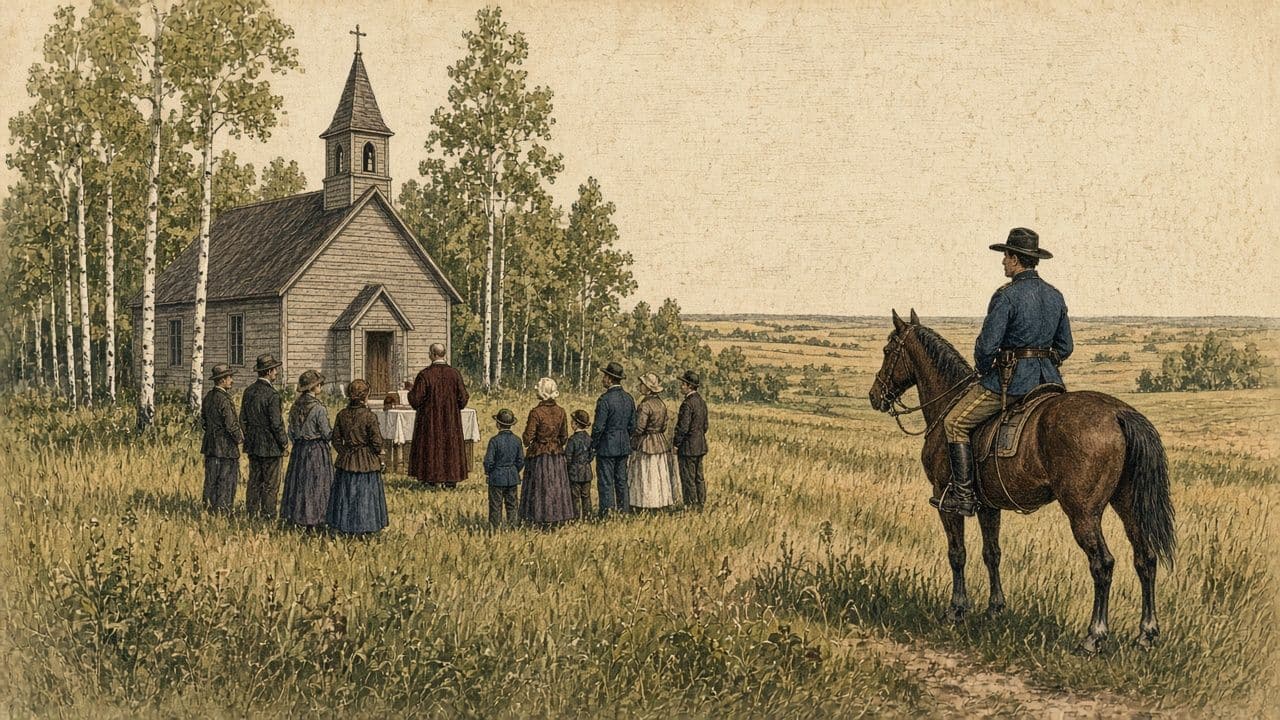
One Sunday the Greek Catholic priest had planned to hold an outdoor service. After the congregation assembled, in the midst of the mass, this policeman came on horseback, with revolver in hand, and told the people that they had to disperse and the church service was canceled.
Illustration: A mounted man near an outdoor service.Illustration: A stack of firewood.
In 1918, a policeman of Polish descent was appointed for Ethelbert by the Provincial government. The Poles and Ukrainians did not get along well, having carried their grievances over from the Old Country. Because of his job, he was in a position to scare people with threats of court action if they didn’t obey his orders. I remember one instance where he asked for and received two chickens from a farmer in exchange for allowing the farmer to water his oxen in the Ethelbert Creek. Many such unfair acts occurred.
The Minister of Education had appointed an official trustee for several schools. The trustee got busy and took over about ten per cent of the schools. This became such a big undertaking for him that he established an office in the legislative building and appointed public trustees all over Manitoba. The strange thing is that they never touched the Ethelbert municipality, but they took over seventy-five per cent of the schools surrounding Ethelbert in the belief that the people were not capable of carrying on their own school activities and hiring teachers. Here is one example of how a public trustee worked. About seven miles east of Ethelbert in the Mossey River municipality, he formed a district and had a school built. He was unfamiliar with the area and selected a spot about five hundred feet from a nice dry ridge. He paid no attention to the protests of the ratepayers. The school was built in the winter months and when spring arrived, it was surrounded by water. The teacher and the children had to wade through water and mud to get to it. They did not want for fish to eat as they could go out on the playgrounds and catch suckers with their bare hands.
In 1919 the constituency of Gilbert Plains was divided in two and the new constituency of Ethelbert was created. Taras Ferley and Yaroslaw Arsenych, a lawyer in Winnipeg, knew all about what was going on in our area and they insisted that I become a candidate and run in the next election which was in 1920. In fact, it was these two men who got me involved in politics.
We did not have much use for the Conservative Party whose politicians, at that time, were peddling booze and cigars among our people trying to get their votes and spreading the word that they could buy our votes with this method. We still had a little sympathy for that party as we appreciated what it had done in establishing a teachers’ training school in Brandon for our young boys and thus provided needed leaders in the community. We did not like the Liberal Party at that time. Therefore, we decided that we would nominate a candidate to run as an Independent Farmer. We held a convention in Ethelbert and I was chosen to be a candidate. The eastern part of the constituency did not approve our convention and they called another convention and nominated Mr. Markroff to the Independent Farmer candidate. The Liberals were not going to be left out and they chose Mr. Gniazdowski of Sifton. The Conservatives didn’t think there was any hope for them and they had no candidate in this campaign. During the campaign, Mr. Markroff and I got along very well. In one instance in Slater, where most of the people couldn’t understand English, I happened to be in the district and acted as interpreter at Mr. Markroff’s meeting. The outcome of the election was that I got sixteen hundred votes, Mr. Markoff [sic] eight hundred and twenty, and Mr. Gniazdowski one hundred. That year Mr. Yakimschak was elected in Emerson and according to the Free Press there were “two Galicians elected and endangering our school system”. Imagine two members out of fifty-two a threat to the school system!
Our first aim - this was under the minority Morris government - was to get our schools back into the hands of the ratepayers. The Minister of Education refused to do anything. The government was defeated in 1922 and our party, the Independent Farmer, was called upon to form the new government with Mr. John Bracken as Premier. I was re-elected by acclamation. In this election Mr. Bachynsky was added to our group of “dangerous people”. The Free Press's prediction of 1920 came true and we finally got rid of the official trustees.
Archival photograph
John Bracken, about 1941. The memoir names him as Premier when the Independent Farmers were called to form the government in 1922, and as one of the two leaders under whom Nicholas served.
Source
I had discussed with the Attorney General the matter of the policemen in our area with whom the settlers were very unhappy but he refused to do anything about the situation. From the things I had observed I was convinced that our policeman was not above board and asked for his vouchers on the floor of the House. On looking through the voucher I found that the policeman had been buying tamarac wood for heating his office which was in his home. He was buying the wood from his wife for $9.00 a cord while the selling price in the village was $2.50 a cord and this was in July. The Attorney General was then forced to fire this man.
I served as an M.L.A. from 1920 to 1945 with the exception of one term when I was defeated by a Social Credit candidate in the depression of the 1930s. During my last term I was the Deputy Speaker and Chairman of the Transportation and Telephones Committee. My twenty year's service as M.L.A. was under the leaderships of Mr. John Bracken and Mr. Douglas Campbell.
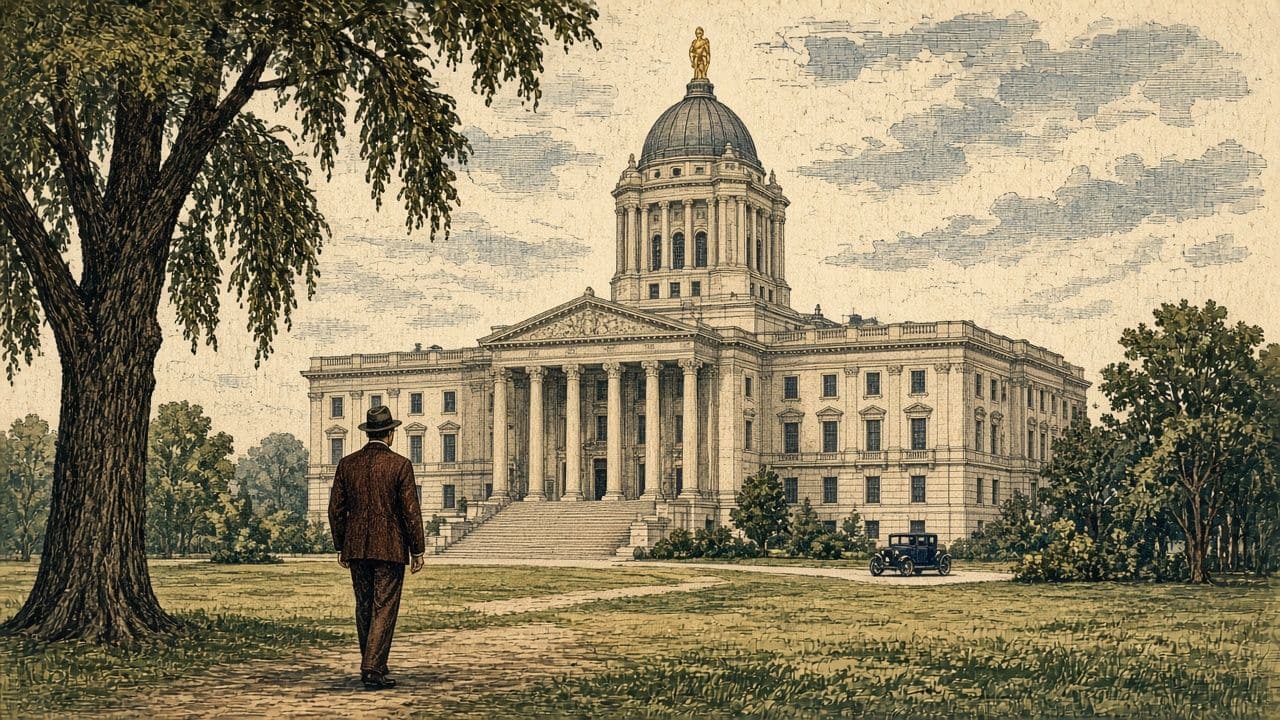
Illustration: A man walking toward a domed building.Archival photograph
The Manitoba Legislative Building, Winnipeg, in a 1922 photograph by Peter McAdam titled “The Capitol.” Nicholas sat in this building as MLA for Ethelbert. British Library, HS85-10-40693.
Source
The Ukrainian members of the Legislature worked well with the other members. We were loyal to Canada and supported only those measures which we believed were good for the people of Manitoba.
Illustrated online edition. The memoir text follows the 2011 copy compiled by Rene Nicholas Bilodeau.